
28 May 2026
Enterprises, Inclusion, Extension, and Cross-country Learning
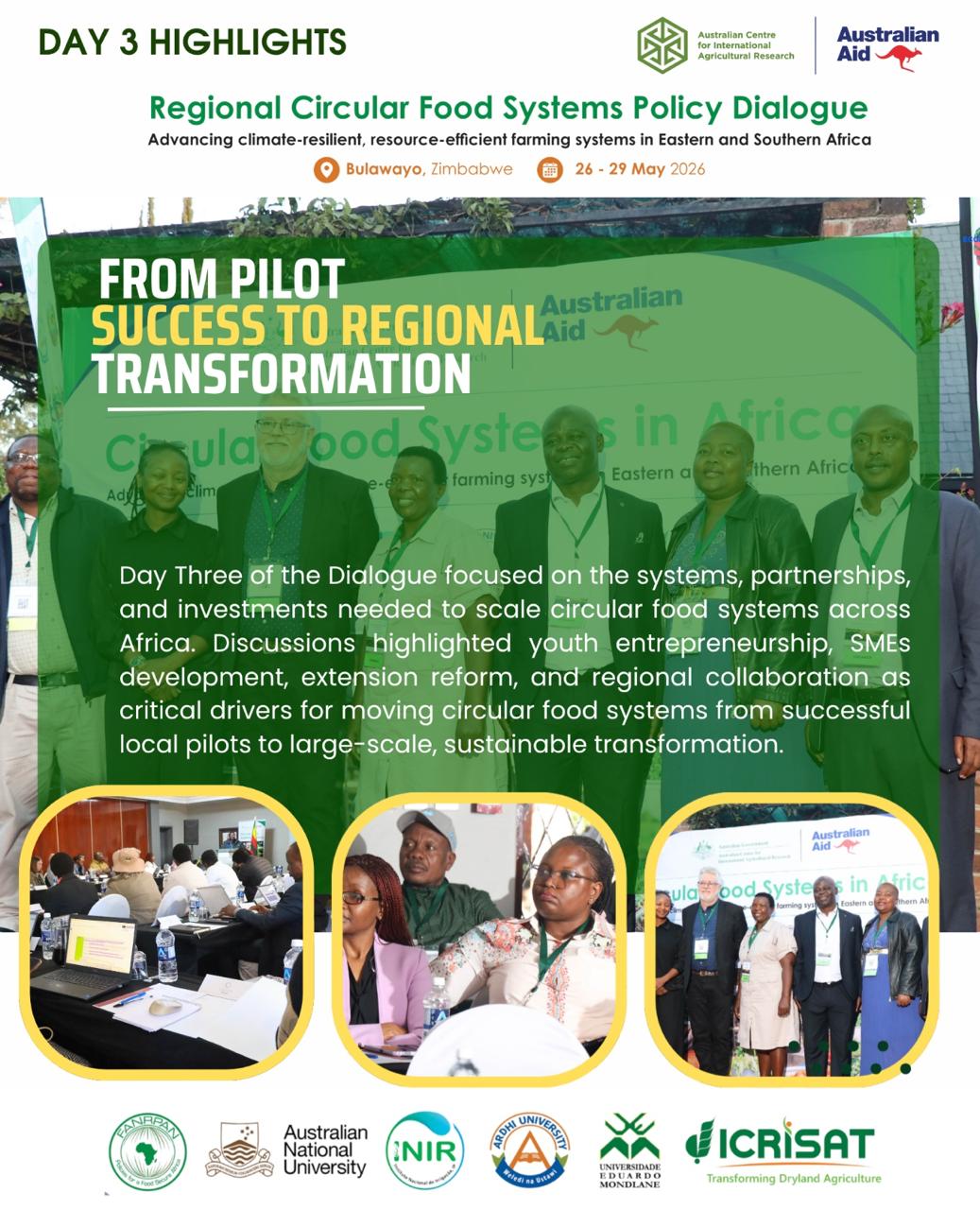
Day 3 of the 2026 Regional Circular Food Systems Policy Dialogue shifted the conversation from field evidence to the enabling systems needed to scale circular food systems across Africa. Discussions focused on youth entrepreneurship, MSME development, extension reform, cross-country learning, and the institutional architecture required to move from successful pilots to sustainable regional uptake.
The morning sessions explored enabling conditions for MSME-driven circularity, with strong emphasis placed on youth participation and enterprise development. A standout message came from SACAU’s Ishmael Sunga, who challenged stakeholders to stop “selling circularity” as a technical concept and instead focus on entrepreneurship and profitability opportunities within circular value chains. Participants agreed that young people are more likely to engage in agriculture when farming offers visible economic returns, ambition, and viable business pathways.
Country experiences demonstrated the practical economic benefits of circular systems. In Tanzania, integrating irrigated maize production with poultry farming significantly reduced feed costs while lowering reliance on chemical fertilisers through manure reuse. These examples reinforced the growing evidence that circular practices can reduce production costs, improve soil fertility, and strengthen household resilience.
The Dialogue also highlighted the evolving role of agricultural extension systems. Zimbabwe shared a major policy shift in which extension officers are being repositioned as “business advisors” rather than solely production advisors. Discussions emphasized that farmers increasingly need support that combines agronomic advice with enterprise development, market access, and financial literacy. Participants noted that strengthening extension systems will be essential for sustaining circular transitions beyond project cycles.
Lead farmers and extension officers raised concerns about the ageing farmer population and the growing migration of youth toward artisanal mining and other livelihood options offering quicker financial returns. Delegates reflected that the challenge is no longer whether youth are willing to work, but whether agriculture can compete economically with alternative sectors.
The afternoon sessions focused on cross-country synthesis and pathways for scaling circular food systems regionally. Presenting a synthesis of lessons across participating countries, Dr Andre van Rooyen introduced a five-level agroecological transition framework. While the CFS project has shown strong progress in reducing external inputs and promoting recycling practices such as composting, manure reuse, and efficient water management, participants acknowledged that more work is needed in economic diversification, market reconnection, and broader food systems redesign.
A memorable reflection emerged during the session: “Pilots never fail, but they also never scale.” This statement captured the central challenge of the Dialogue, how to move from successful local demonstrations to institutionalised, large-scale adoption supported by governance systems, financing mechanisms, and coordinated policy frameworks.
Regional institutions shared examples of existing policy entry points for scaling circularity. The East African Community (EAC) highlighted alignment with regional frameworks on youth empowerment, gender equality, and social development, while Rwanda’s National Circular Economy Action Plan was cited as a leading example of integrating circularity into national policy.
The WEFE (Water-Energy-Food-Ecosystems) Nexus emerged as another key framework for regional scaling. Presentations from GWPSA, Dabane Water Workshops, and LIMCOM demonstrated how circular food systems can be linked to transboundary basin management, climate resilience, irrigation development, and ecosystem restoration across the Limpopo, Zambezi, and Incomati basins.
Throughout the day, participants identified both major opportunities and persistent constraints. Strong evidence now exists showing that circular practices reduce input costs and improve productivity, particularly where locally available materials are used. However, scaling remains constrained by limited access to capital, inadequate processing technologies, under-resourced extension systems, fragmented policy coordination, and weak institutional mechanisms linking agriculture, environment, and health sectors.
By the close of Day 3, the Dialogue had sharpened its focus on the critical transition from pilot success to regional transformation. Participants agreed that achieving scale will require coordinated investment frameworks, climate finance integration, stronger governance systems, and deliberate efforts to position circular food systems within national and regional development priorities.