


- Period
- October 2023 to June 2026
- Countries
- Mozambique, Tanzania, Zimbabwe
- Funder
- Australian Government, through the Australian Centre for International Agricultural Research (ACIAR)
- Project code
- WAC/2023/111
- Resources
- 54
- Status
- Past project
About the project
Overview
The Circular Food Systems in Africa (CFS) project brings irrigation, livestock and dryland farming together to build climate-smart, circular food systems in Mozambique, Tanzania and Zimbabwe.
Smallholder irrigation schemes are the starting point. From there, the project works to use natural resources more sustainably, improve local livelihoods and strengthen resilience to climate change.
Solutions are co-designed with local stakeholders, with a clear focus on women and young people. The project supports small, medium and micro enterprises, reduces resource use, strengthens value chains, and looks for ways to scale up good practice through policy reform and new financing.
In at least five localities, agricultural innovation platforms bring farmers, enterprises and local institutions together to build a shared understanding of circularity, including local jobs for women and other underserved groups in adding value to what is produced. The aim is better food security, local economic growth and climate resilience, with social and economic gains that do not come at the cost of the environment.
The idea
One system, not separate farms
The project links irrigation, livestock and dryland production with local enterprises around the irrigation scheme. Resources are used more productively, and more of the value stays in the community.
- Co-designed with farmers and local stakeholders
- Built around women and young people in enterprise
- Tested for scale through policy and finance
What it sets out to do
Objectives and intended outcomes
Research objectives
- 01
To identify conditions for the successful establishment of circular food systems, centred on irrigation schemes serving smallholder farming communities.
- 02
To identify approaches to improve gender equality and social inclusion in circular food systems and local food systems, and the conditions that improve food security and livelihoods.
- 03
To investigate whether circular food systems decouple resource use from rising socio-economic benefit, and enable more resilient communities and low-emission agriculture.
Intended outcomes
Evidence base
A stronger evidence base on how circular food system interventions use natural resources, particularly water and land, more productively and create sustainable local food systems and resilient rural communities in a changing climate.
Decoupling growth from resource use
A stronger evidence base on how these interventions decouple growth in social and economic benefits, including local livelihood opportunities for women and youth, from the consumption of natural resources.
Scaling out
A stronger evidence base on how these interventions can be self-sustaining, scale out on their own, and be scaled out through policy reform at district, provincial and national levels.
Gender and inclusion
Stronger leadership and decision-making by women, youth and other underserved groups, with better access to economic assets and opportunities.
From the field
The 2026 dialogue and field visit
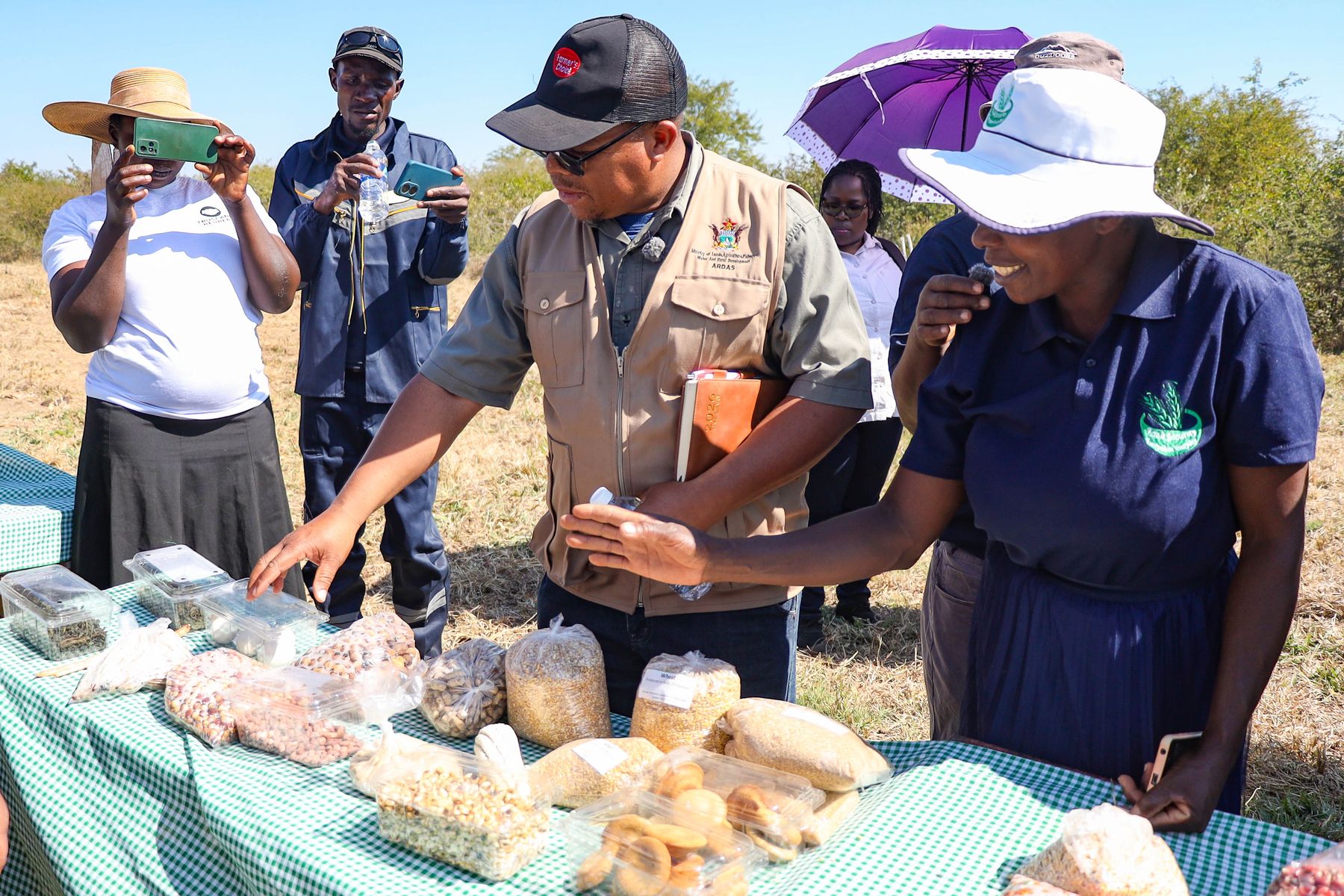
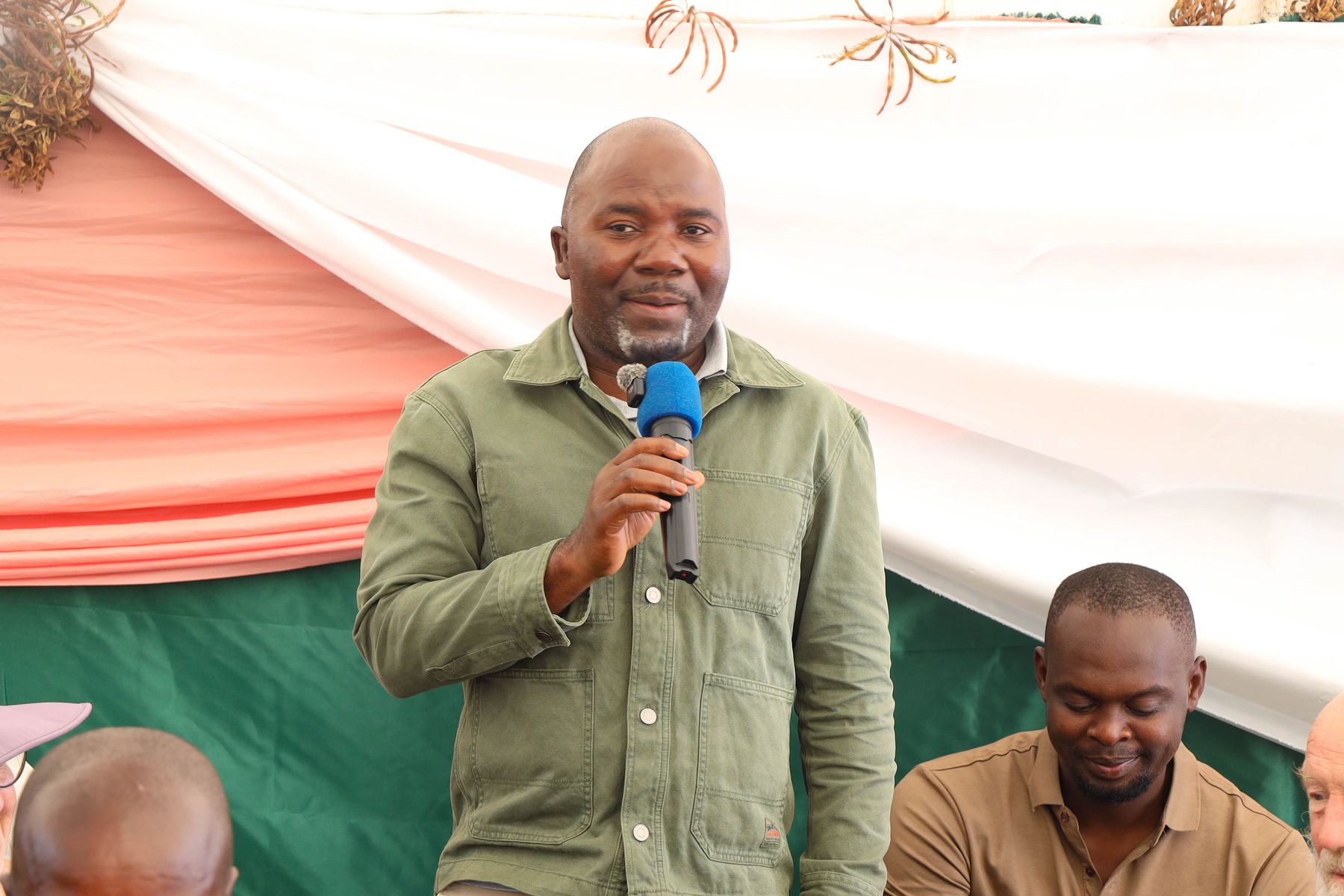
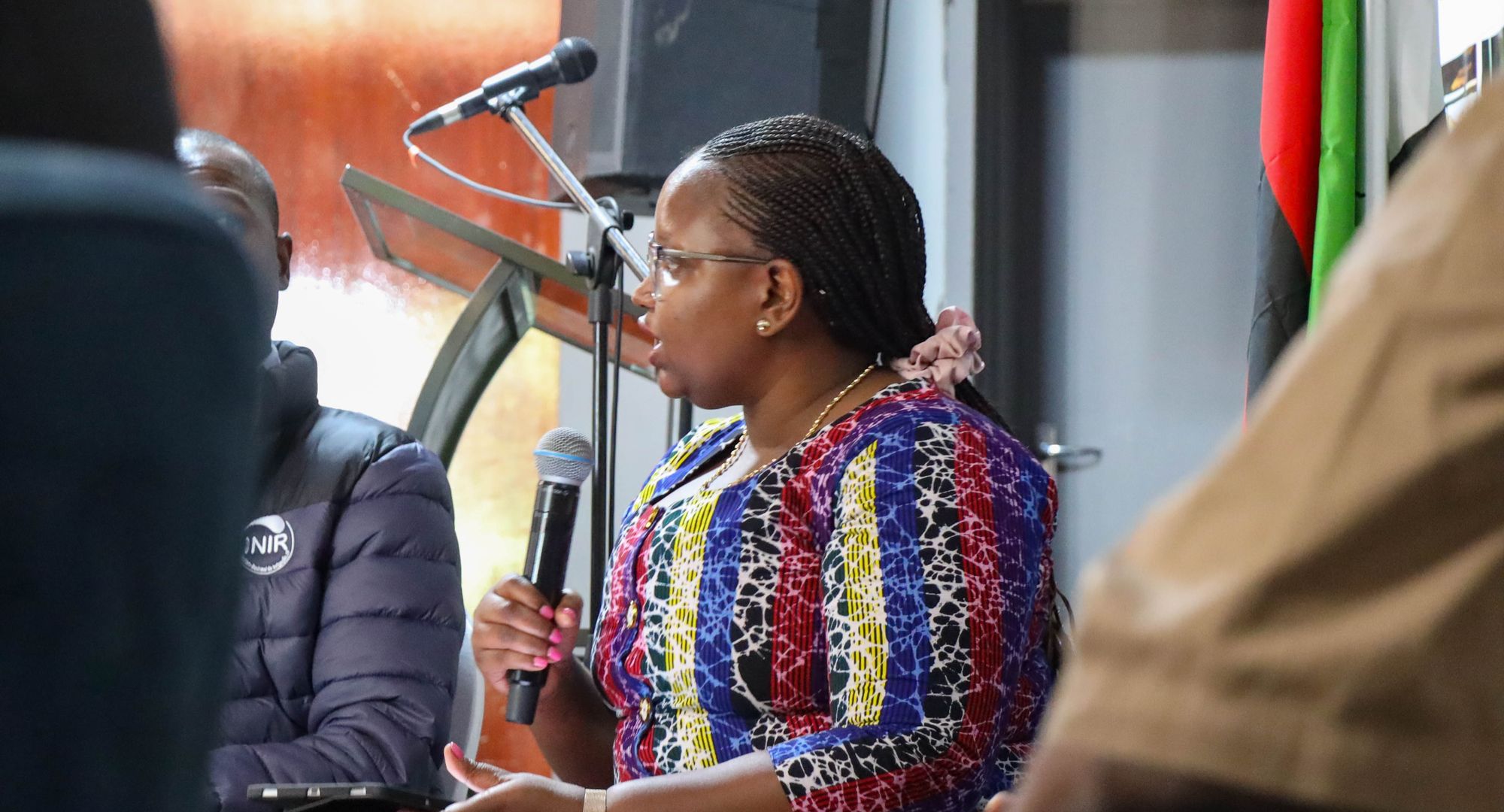
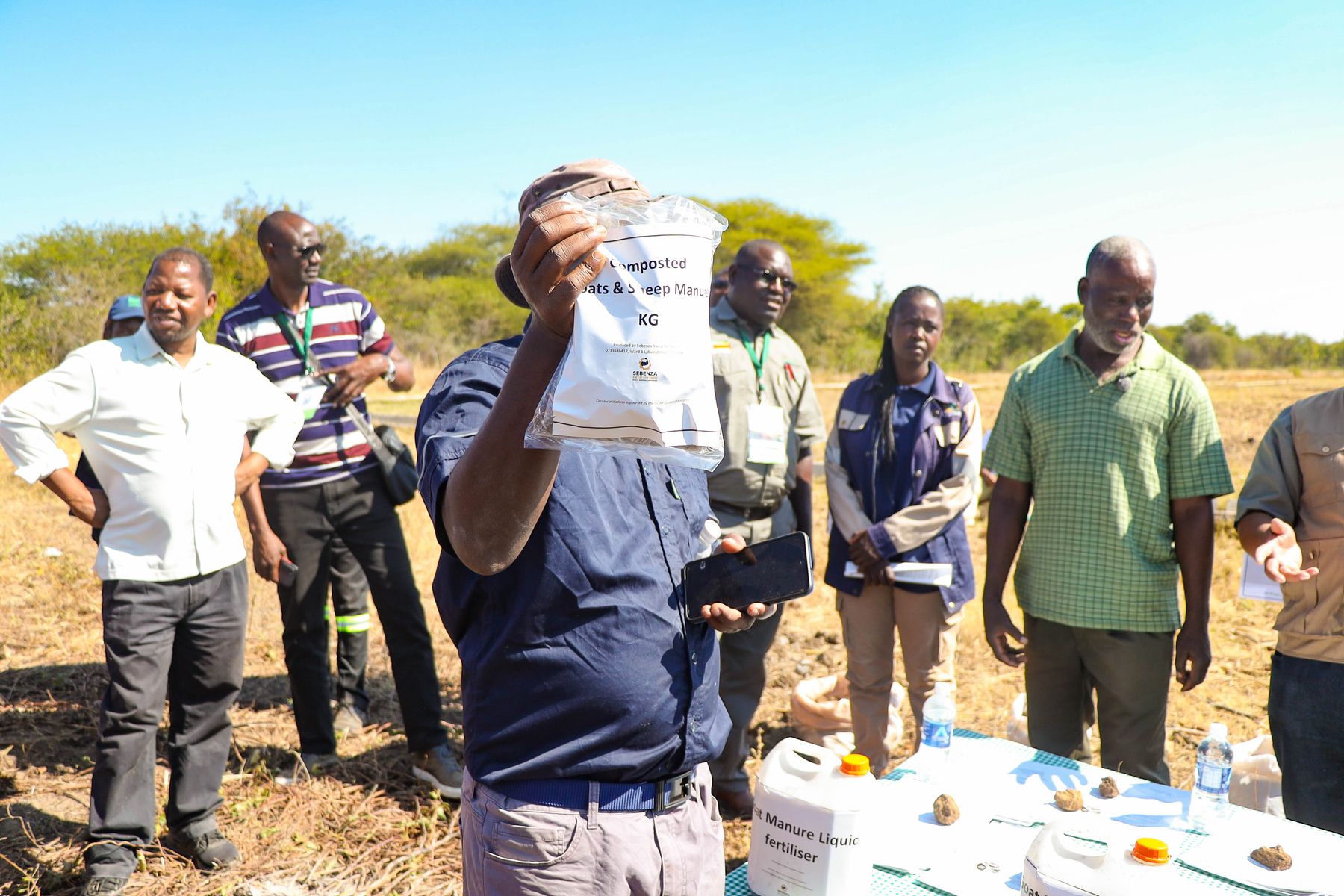
At the 2026 Circular Food Systems Policy Dialogue in Bulawayo, delegates spent a day with farmers in the field before returning to the policy discussion.


Latest from the project
Knowledge briefs
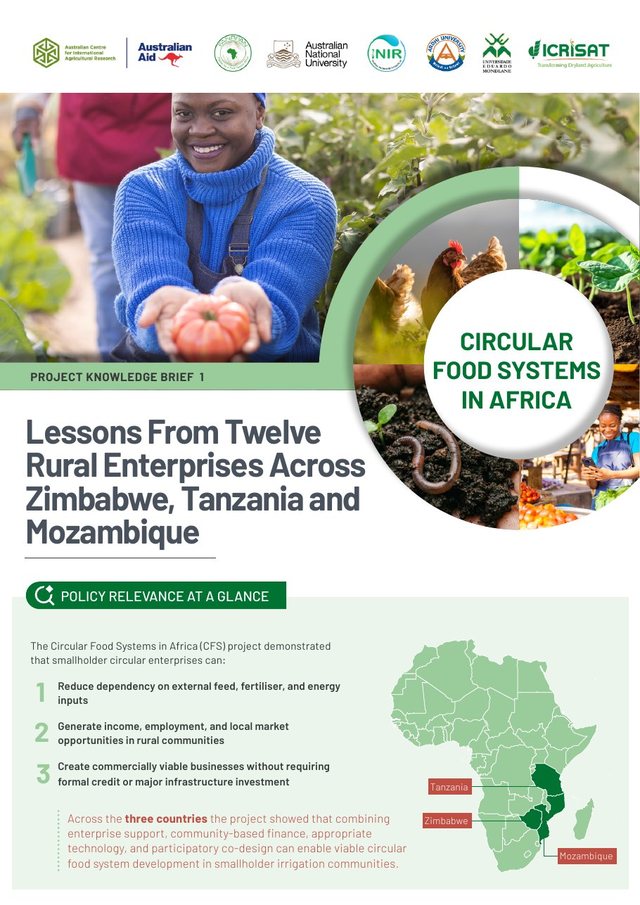
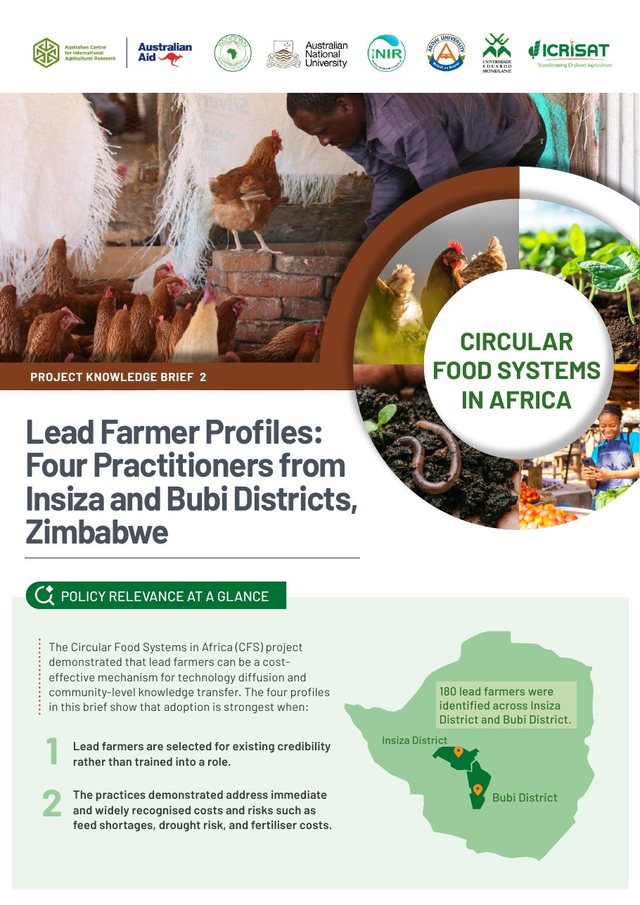
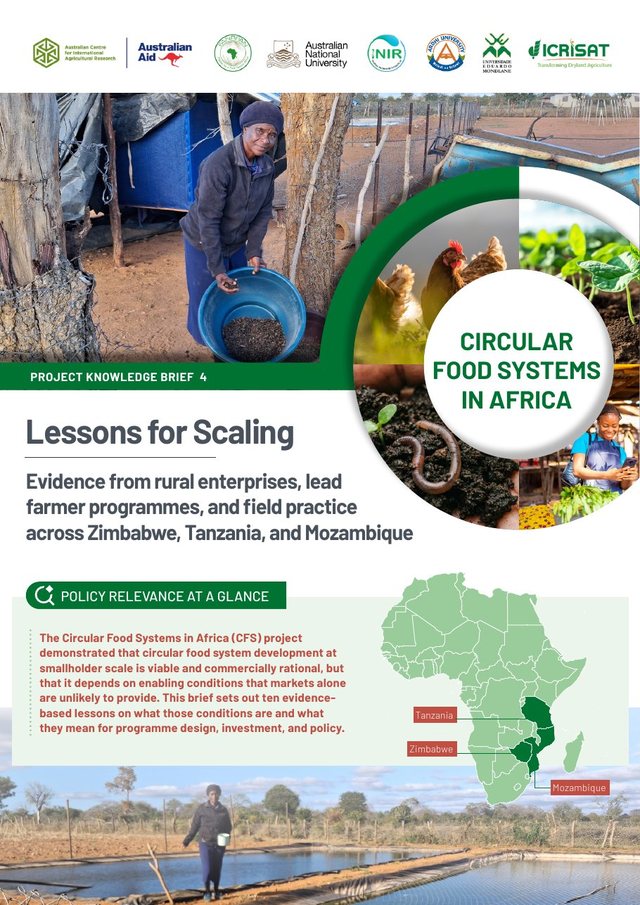
Four short briefs that bring together what the project has learned on enterprises, lead farmers, inclusion and scaling.

Resources
Project library
Every publication, report and story linked to the project, in one place. Filter by type or search by title, author or country.
54 of 54 items
-
Knowledge briefs | 2026
Lessons from Twelve Rural Enterprises
CFS Knowledge Brief 1
Zimbabwe, Tanzania and Mozambique
-
Knowledge briefs | 2026
Lead Farmer Profiles from Insiza and Bubi, Zimbabwe
CFS Knowledge Brief 2
-
Knowledge briefs | 2026
Women, Youth and Inclusive Outcomes
CFS Knowledge Brief 3
-
Knowledge briefs | 2026
Lessons for Scaling Circular Food Systems
CFS Knowledge Brief 4
-
Journal articles | 2026New
Assessing farmers’ ability to pay the full cost of operation and maintenance in small-scale irrigation schemes: insights from Tanzania and Mozambique
Kissoly, L., Mdemu, M., Chilundo, M., de Sousa, W., Bjornlund, H., van Rooyen, A. and Pittock, J.
Water International
-
Journal articles | 2025
Transforming smallholder irrigation systems from dysfunctional to functional climate-smart agricultural systems
International Journal of Water Resources Development 41(2), special issue
-
Journal articles | 2025
Combining socio-institutional and technological innovations for sustained change in small-scale irrigation schemes in sub-Saharan Africa
Bjornlund, H., Parry, K., van Rooyen, A. and Pittock, J.
Agricultural Water Management 309, 109330
-
Journal articles | 2025
Institutions influencing plot access and intergenerational land transfer: policy insights from a smallholder irrigation scheme in Zimbabwe
Parry, K., Cooper, B., Bjornlund, H., Crase, L., Moyo, M. and Dube, T.
Journal of Rural Studies 114, 103576
-
Journal articles | 2025
Women, youth, and tail-end users: improving the livelihoods of disadvantaged irrigators in southern Africa
International Journal of Water Resources Development
-
Journal articles | 2025
Agroecology and circular food systems: decoupling natural resource use from rural development in sub-Saharan Africa?
International Journal of Water Resources Development
-
Journal articles | 2024
Equal Opportunity Sensitive Aggregate Wellbeing Measurement: Food Security and Basic Household Income on Sub Sahara African Farms
Anderson, G., Manero, A. and Bjornlund, H.
Review of Development Economics
-
Journal articles | 2023
Participatory mapping of irrigation schemes in Tanzania, Mozambique and Zimbabwe
Mdemu, M., Kimaro, E., Tafula, M., de Sousa, W., Moyo, M., Parry, K., Bjornlund, H., Mukwakwami, P. and Ramshaw, P.
Agricultural Water Management 290, 108591
-
Journal articles | 2023
The welfare enhancing effects of agricultural innovation platforms and soil moisture and nutrients monitoring tools on farming household outcomes in sub-Saharan Africa
Abebe, F., Wheeler, S., Zuo, A. and Bjornlund, H.
International Journal of Agricultural Sustainability 21(1)
-
Journal articles | 2023
Research and development needs in agricultural water management to achieve Sustainable Development Goals
Bjornlund, H., van Rooyen, A., Pittock, J. and Bjornlund, V.
Irrigation and Drainage
-
Journal articles | 2022
The influences on farmers’ planned and actual farm adaptation decisions: evidence from small-scale irrigation schemes in sub-Saharan Africa
Abebe, F., Wheeler, S., Zuo, A., Bjornlund, H., Chilundo, M., Kissolye, F. and Dube, T.
Ecological Economics 202
-
Journal articles | 2022
Why food insecurity persists in sub-Saharan Africa: a review of existing evidence
Bjornlund, V., Bjornlund, H. and van Rooyen, A.
Food Security (Springer Nature)
-
Journal articles | 2021
Changing the development paradigm in African agricultural water management to resolve water and food challenges
Bjornlund, H., van Rooyen, A., Pittock, J. and Bjornlund, V.
Water International 46(7-8), 1187-1204
-
Journal articles | 2021
Beyond fertilizer for closing yield gap in sub-Saharan Africa
van Rooyen, A., Bjornlund, H. and Pittock, J.
Nature Food
-
Journal articles | 2020
Institutional innovation and smart water management technologies in small-scale irrigation schemes in southern Africa
Bjornlund, H., van Rooyen, A., Pittock, J., Parry, K., Moyo, M., Mdemu, M. and de Sousa, W.
Water International 45(6), 621-650
-
Journal articles | 2019
Understanding agricultural water management in a historical context using a socioeconomic and biophysical framework
Bjornlund, V. and Bjornlund, H.
Agricultural Water Management 213, 454-467
-
Journal articles | 2019
The dynamics of the relationship between household decision-making and farm household income in small-scale irrigation schemes in southern Africa
Bjornlund, H., Zuo, A., Wheeler, S., Parry, K., Pittock, J., Mdemu, M. and Moyo, M.
Agricultural Water Management 213, 135-145
-
Special issues | 2025
International Journal of Water Resources Development, Volume 41, Issue 2
-
Special issues | 2020
International Journal of Water Resources Development, Volume 36, Supplement 1
-
Special issues | 2017
International Journal of Water Resources Development, Volume 33, Issue 5
-
Policy briefs | 2025
Opportunities for Transitioning to Circular Food Systems in Tanzania
-
Policy briefs | 2025
Opportunities for Transitioning to Circular Food Systems in Zimbabwe
-
Policy briefs | 2025
Opportunities for Transitioning to Circular Food Systems in Mozambique
-
Policy briefs
Investment Priorities for Transforming Climate Resilience and Mitigation in Sub-Saharan Africa Farming Systems
-
Policy briefs
Transitioning to Climate-Resilient Farming Systems in Sub-Saharan Africa
-
Reports | 2026
CFS Business Case Studies in East and Southern Africa
-
Reports | 2026
Circular food system project: lead farmer case studies from East and Southern Africa
Report, April 2026
-
Reports | 2026
CFS business case studies report
Report, May 2026
-
Reports | 2025
Circular Food Systems in Zimbabwe: A Policy Review and Gap Analysis
-
Reports | 2025
Circular Food Systems in Tanzania: A Policy Review and Gap Analysis
-
Reports | 2025
Circular Food Systems in Mozambique: A Policy Review and Gap Analysis
-
Reports | 2024
Validation meeting: Policy Review and Gap Analysis in Zimbabwe
Meeting report, June 2024
-
Reports | 2024
Validation meeting: Policy Review and Gap Analysis in Tanzania
Meeting report, June 2024
-
Reports | 2024
Validation meeting: Policy Review and Gap Analysis in Mozambique
Meeting report, June 2024
-
Reports | 2024
Agri-MSMEs Business Survey Report
Report, August 2024
-
Reports | 2024
Business Development Training of Trainers Report, Tanzania
Workshop report, September 2024
-
Reports | 2024
Business Development Training of Trainers Workshop Report, Zimbabwe
Workshop report, September 2024
-
Reports | 2024
Monocropping and implications for food security in sub-Saharan Africa
Bjornlund, V. and Bjornlund, H.
2023 Annual Report of the Nestle Foundation, Lausanne
Citation only -
Reports | 2023
Why food insecurity persists in sub-Saharan Africa
Bjornlund, V., Bjornlund, H., van Rooyen, A. and Pittock, J.
2022 Annual Report of the Nestle Foundation, pp. 38-41
-
Reports | 2020
Transforming small-scale irrigation in southern Africa
Bjornlund, H., Parry, K., Pittock, J. and van Rooyen, A.
ACIAR Technical Report 92, Canberra, 19-26
-
Book chapters | 2021
Water markets in Africa: an analysis of Mozambique, Tanzania and Zimbabwe
Pittock, J., Blessington, L., Christen, E., Bjornlund, H., Chilundo, M., Kujinga, K., Manzungu, E., Mdemu, M., van Rooyen, A. and de Sousa, W.
In Wheeler, S. (ed.) Water Markets: A Global Assessment, Edward Elgar
-
Book chapters | 2018
Transforming smallholder irrigation into profitable and self-sustaining systems in southern Africa
Bjornlund, H., Parry, K., Pittock, J., Stirzaker, R., van Rooyen, A. et al.
Smart Water Management: Case Study Report, K-water and IWRA, 330-384
-
Commentary | 2025
We studied smallholder farming in three African countries for 10 years: why profitable irrigation is key
The Conversation
-
Commentary | 2021
Tracing the history of farming across Africa gives clues to low production outputs
Bjornlund, H., van Rooyen, A. and Bjornlund, V.
The Conversation Africa
-
Stories and media | 2025
CFS Tanzania: Magozi and Kiwere visit snapshot
FANRPAN news
-
Stories and media
Building capacity in crop modelling to advance circular food systems in southern Africa
ICRISAT press room
-
Stories and media
Nurturing agricultural excellence through the ACIAR JDF program
ACIAR blog
-
Stories and media
Empowering Entrepreneurs in Tanzania
-
Stories and media
Agri-Innovation Takes Root in Africa: Empowering Small Businesses for a Sustainable Future
-
Posters
Building Resilient Value Chains: Circular Food Systems for Africa’s Corridors
Citation only
No items match your search.
Watch
Partnerships for climate-resilient agriculture in Zimbabwe
A short film by ACIAR on the partnerships behind climate-resilient farming in Zimbabwe. The film opens on YouTube.

In the news
When nothing goes to waste
For World Food Day 2026, ACIAR told the story of this project in an article and a short film. They follow farmers in Mozambique, Tanzania and Zimbabwe who turned crop residues and other farm by-products into feed, fertiliser savings and new rural businesses.
Working together
Partners
Watch
Videos from the 2026 dialogue
The film, daily highlights, every session in full and interviews from the 2026 Regional Circular Food Systems Policy Dialogue in Bulawayo, Zimbabwe.
Film and field day
The short film of the Dialogue, and the field day at the pilot site in Insiza District.
 7:33
 59:20
Daily highlights
A few minutes from each of the four days.
 3:29
 2:58
 5:14
 4:30
Full session recordings
Every session of the Dialogue, recorded in full.
 1:12:28CFS Policy Dialogue 2026, Session 1: Official Opening and Africa-wide Positioning of the Dialogue
 2:13:43CFS Policy Dialogue 2026, Session 2: Policy Priorities and Investment Pathways
 1:29:54CFS Policy Dialogue 2026, Session 3: Technological and Governance Innovations
 1:14:30CFS Policy Dialogue 2026, Session 4: Resilience, Productivity and Agroecology
 1:42:49CFS Policy Dialogue 2026, Session 5: Small Enterprises, Youth and Inclusion
 2:07:03CFS Policy Dialogue 2026, Session 6: Working with Lead Farmers
 1:29:05CFS Policy Dialogue 2026, Session 7: Cross-country Lessons and Knowledge Needs
 1:35:54CFS Policy Dialogue 2026, Session 8: The Water-Energy-Food-Ecosystems Nexus
 1:53:58CFS Policy Dialogue 2026, Session 9: Evidence for Climate Policy and Finance
 1:38:20CFS Policy Dialogue 2026, Session 10: Synthesis, Regional Policy Statement and Closing
Voices from the Dialogue
Short interviews with speakers, policymakers, researchers and farmers.
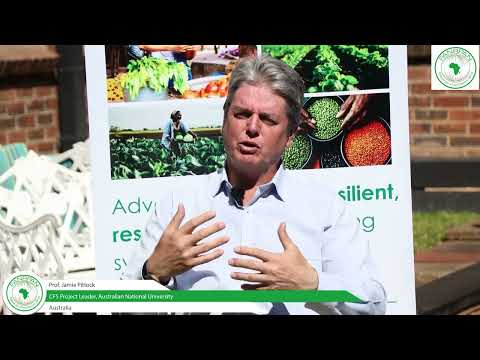 4:32Voices from the CFS Policy Dialogue 2026: Prof Jamie Pittock, Australian National University
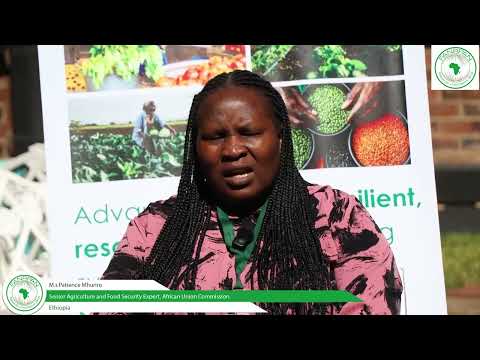 1:41Voices from the CFS Policy Dialogue 2026: Ms Patience Mhuriro, African Union Commission
 2:21Voices from the CFS Policy Dialogue 2026: Mr Valerian Vitalis Kidole, East African Community
 2:44Voices from the CFS Policy Dialogue 2026: Mr Euclides Mazive, INIR, Mozambique
 1:22Voices from the CFS Policy Dialogue 2026: Mr Emmanuel Kimaro, Tanzania
 2:20Voices from the CFS Policy Dialogue 2026: Dr Makarius Mdemu, Ardhi University, Tanzania
 2:59Voices from the CFS Policy Dialogue 2026: Ms Lucia Nhliziyo, Lead Farmer, Zimbabwe
 3:32Voices from the CFS Policy Dialogue 2026: Ms Edith Nyatsanga
 3:19Voices from the CFS Policy Dialogue 2026: Mr Mtshado Ngwenya
 2:24Voices from the CFS Policy Dialogue 2026: Mr Mark Khabo
 4:37Voices from the CFS Policy Dialogue 2026: Mr Augustine Mhike
 5:56Voices from the CFS Policy Dialogue 2026: Dr Martin Moyo, ICRISAT Zimbabwe
Livestream recordings
The full-day livestreams as they were broadcast.
 9:15:15
 9:54:48
 4:28:26