
26 May 2026
From Policy to Practice — Circularity in Action at the CFS Pilot Site
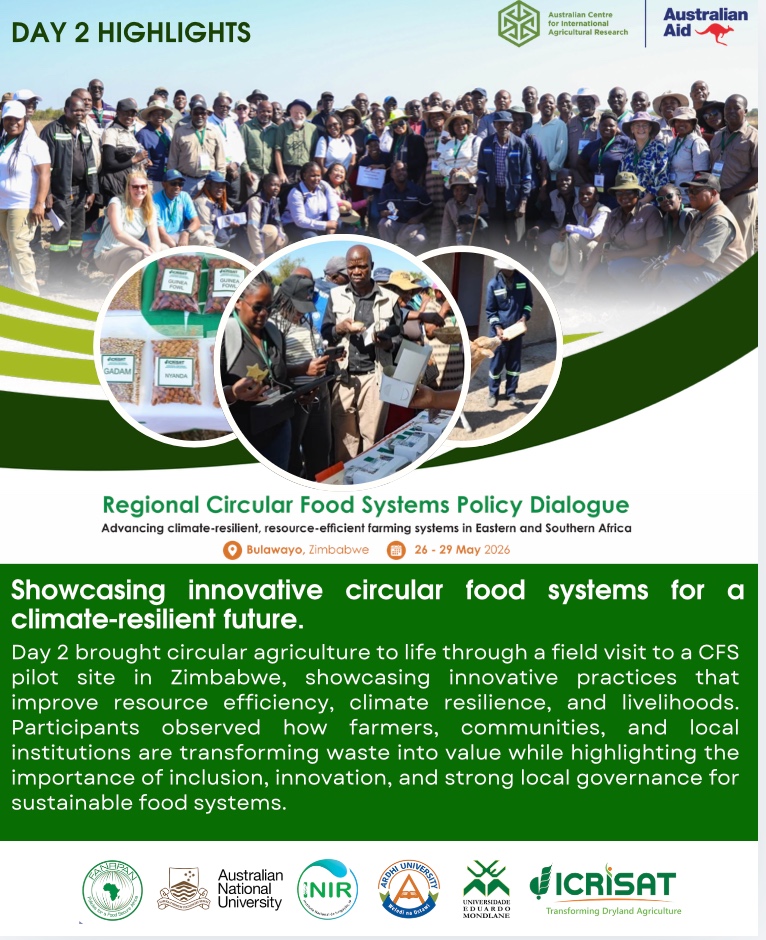
Day 2 of the 2026 Regional Circular Food Systems Policy Dialogue moved discussions from conference rooms into the field, allowing delegates to experience circular food systems in practice at the Circular Food Systems (CFS) pilot site in Zimbabwe.
The Full Field Day showcased how farmers, local institutions, and communities are applying circular approaches to agriculture through integrated crop-livestock systems, water-efficient irrigation, by-product reuse, composting, fodder production, and enterprise diversification. Delegates engaged directly with farmers, extension officers, researchers, and local enterprises to observe practical examples of resource efficiency and climate resilience.
Participants received briefings on scheme governance, enterprise mapping, and climate and water management systems operating within the irrigation scheme. Farmers demonstrated how crop residues are converted into livestock feed, manure is transformed into compost, and local materials are used to produce mineral lick blocks, reinforcing the principle that “nothing goes to waste” within a circular system.
The field visit also highlighted the role of local governance structures in sustaining circular food systems. Farmer committees and sub-committees oversee production, marketing, irrigation operations, discipline, and scheme maintenance, demonstrating how strong local organisation contributes to resilience and sustainability.
Technology demonstrations further illustrated how innovation can strengthen resource management. Chameleon soil-water monitoring tools were showcased as practical technologies helping farmers improve irrigation scheduling, reduce overwatering, and minimise nutrient loss. Delegates also explored water and energy efficiency practices integrated into the farming system.
Youth and women enterprise showcases formed an important part of the programme, highlighting opportunities for inclusive enterprise development within circular food systems. Discussions focused on strengthening MSME participation, supporting local innovation, and ensuring that women and young people move beyond participation toward ownership and economic benefit within agri-food value chains.
At the same time, farmers openly shared the challenges limiting scale and sustainability. Key constraints identified included flooding and damaged irrigation canals, rising input and transport costs, pest pressures, limited cold chain infrastructure, weak market access, and an ageing farmer population as many young people leave agriculture for alternative livelihoods.
The field immersion reinforced several key lessons emerging from the Dialogue: policy and practice must work together; farmer innovation is often ahead of support systems; systems thinking is essential; and inclusion requires deliberate investment and support mechanisms.