
26 May 2026
Setting the Policy and Investment Agenda for Circular Food Systems in Africa
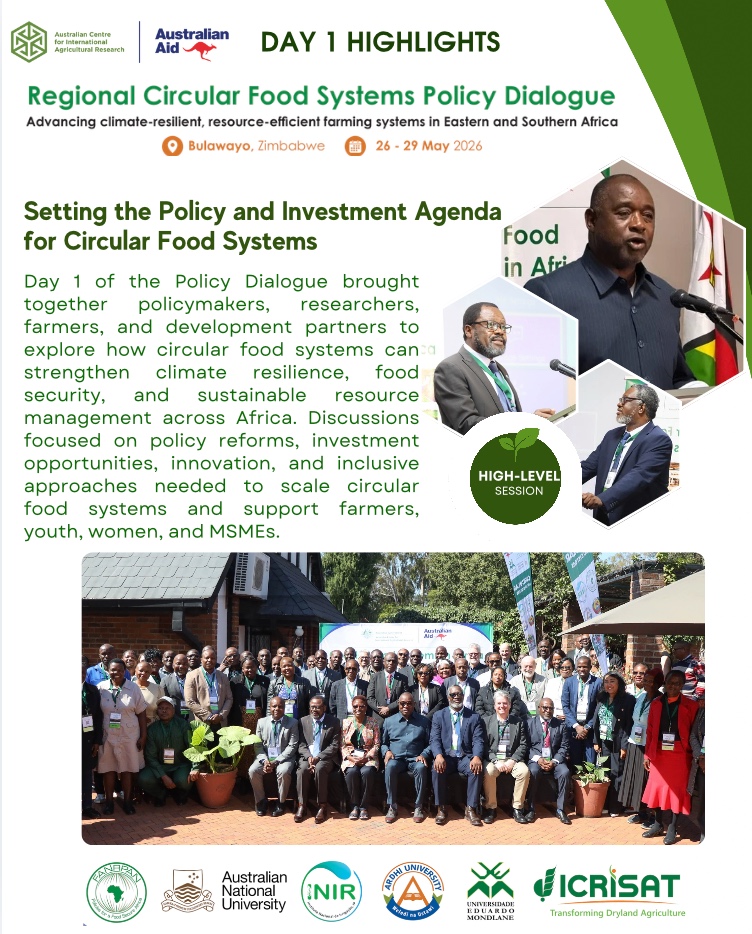
The 2026 Regional Circular Food Systems Policy Dialogue was officially opened by the Deputy Minister of Agriculture, Mechanisation and Water Resources Development, Hon. Davis Marapira, in Bulawayo, Zimbabwe, bringing together policymakers, researchers, development partners, private sector actors, farmers, and regional institutions to advance climate-resilient and resource-efficient food systems in Eastern and Southern Africa.
Hosted under the theme “Advancing climate-resilient, resource-efficient farming systems in Eastern and Southern Africa,” Day 1 focused on positioning circular food systems (CFS) as a practical and scalable pathway for strengthening food security, climate resilience, enterprise development, and sustainable natural resource management across the continent.
The opening session featured keynote contributions from government representatives, FANRPAN, ICRISAT, and development partners, highlighting the growing importance of circularity in responding to climate change, resource degradation, and rising food insecurity. Discussions emphasized the need for stronger regional collaboration, inclusive policy frameworks, and investment mechanisms that support smallholder farmers, women, youth, and micro- and small enterprises (MSMEs).
A major focus of the day was identifying policy priorities and investment pathways needed to scale circular food systems. Participants explored blended finance models, de-risking instruments, incentives, public budgeting mechanisms, and governance reforms required to support MSME-led circular transitions. Stakeholders from ACIAR, the African Union Commission, the Agriculture Research Council-South Africa, universities, and private sector institutions shared perspectives on how governments and development finance institutions can better support circular agribusiness innovation and inclusive value chains.
The Policy Dialogue also examined technological and governance innovations enabling circular food systems implementation. Discussions highlighted the role of water governance, climate-smart technologies, soil and nutrient recycling, integrated agro-systems, and institutional coordination in accelerating adaptation and scale-out across Africa. Participants stressed that circular food systems require systems thinking that links water, energy, food, soil health, livestock, markets, and enterprise development rather than treating them as separate sectors.
Another important discussion centred on agroecology as a complementary pathway for circular transitions. Drawing on experiences from Zimbabwe and across the region, participants reflected on how agroecological approaches can strengthen resilience, improve productivity, reduce waste, and enhance ecosystem restoration while supporting farmer livelihoods.
Across the sessions, a recurring message emerged clearly: Africa’s farmers and local enterprises are already innovating and practising circularity, but scaling impact will require stronger policy support, finance, extension systems, infrastructure investment, and market linkages. Day 1 therefore, laid the foundation for translating evidence and local innovation into actionable regional policy recommendations and investment priorities.