

Pretoria, South Africa — 27–29 October 2025
FANRPAN co-convened the Regional Workshop on Food Loss and Waste (FLW) Prevention in Sub-Saharan Africa at Future Africa Campus, University of Pretoria. The Workshop was co-convened together with the Thünen Institute (Germany), the Global Research Alliance (GRA), and partners from South Africa, Germany, and New Zealand under the Collaboration Initiative on Food Loss and Waste (AgriDENZ).
The three-day regional dialogue convened policymakers, researchers, and development practitioners from across Africa to share strategies for reducing food loss and waste. Sessions explored policy integration, measurement and data systems, climate impacts, and the science–policy interface, reinforcing the need for collaborative, evidence-based action across the continent.

Photo: Mr. Bonani Nyhodo (South Africa FANRPAN Node Coordinator), during the opening session of the Regional Workshop on Food Loss and Waste Prevention in Sub-Saharan Africa at Future Africa, University of Pretoria.
FANRPAN’s Dr Rachel Mkandawire and Ms Sithembile Mwamakamba presented “Food Loss Reduction in Grain and Pulses on Smallholder Farms – Lessons from Benin and Mozambique.”
Drawing on FANRPAN’s experience implementing the Post-Harvest Management in Sub-Saharan Africa (PHM-SSA) initiative, the presentation shared how over 11,000 smallholder households, 35% of them women-led, successfully reduced post-harvest losses by up to 50% through improved storage, handling, and technology adoption.
The presentation highlighted that reducing food loss is not only an economic and food security priority but also a climate action opportunity, as post-harvest losses contribute significantly to greenhouse gas emissions from decomposing crops.
FANRPAN also convened a side event titled “Integrating Gender Roles, Social Equity, and Post-Harvest Management Policies to Improve Rural Households’ Food Security.”
The discussion explored how gender and social equity intersect with post-harvest management, emphasizing that technical solutions alone are not enough without addressing the underlying inequalities in access to finance, technologies, and decision-making.
Drawing from experiences across East, Southern, and West Africa, the session showcased best practices that enhance women’s and youth participation in post-harvest value chains and outlined pathways to embed equity into future FLW strategies.
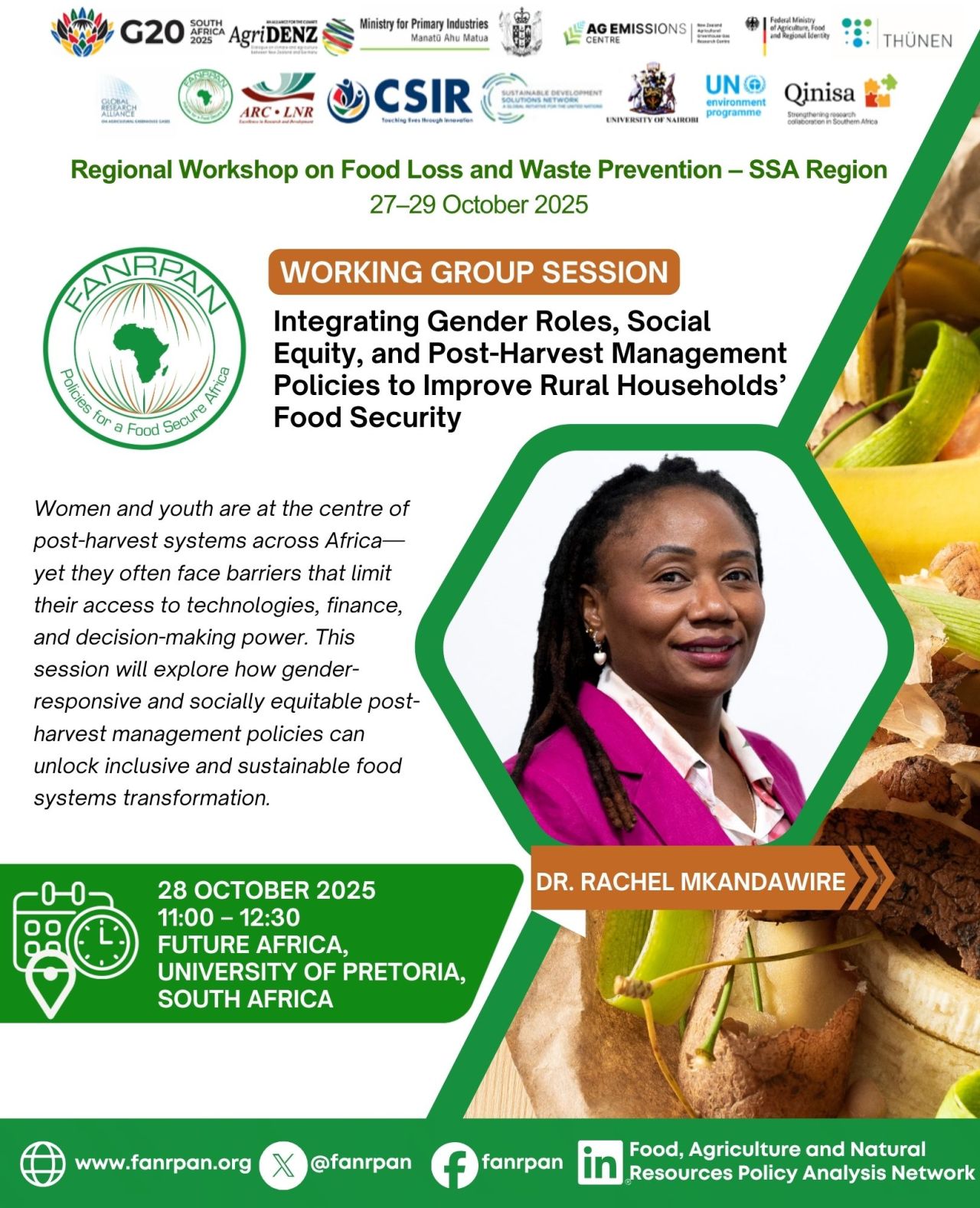

Photo: Exhibition showcasing innovative processed and dried products, underscoring practical post-harvest and value-add solutions.
FANRPAN’s contributions reaffirmed that addressing food loss is both a technical and social challenge requiring gender-responsive, climate-smart, and inclusive policy approaches to achieve SDG 2 (Zero Hunger), SDG 5 (Gender Equality), and SDG 12 (Responsible Consumption and Production).
The event concluded with a strong call to continue fostering evidence-based partnerships and policy innovation to build resilient, equitable, and sustainable African food systems.